Welcome to my coverage of the 2013 Primetime Emmys. As it’s less than a month away, I’ve decided to start a series in which I offer up my dream ballot for each major category. Then, I’ll look at the actual Emmy ballot and offer a “Who should win?” and a “Who Will Win?” for each. I hope you enjoy! Today, we’ll be looking at….
OUTSTANDING SUPPORTING ACTRESS IN A DRAMA SERIES
Dream Ballot
MONICA POTTER, “Parenthood”
Potter’s arc in the past season is one that has been done to death in various television shows and movies, but she brings a new kind of vulnerability and complexity to it. Kristina Braverman is just searching for normalcy, and she can make you laugh and cry all at once.
ABIGAIL SPENCER, “Rectify”
Spencer plays Amantha Holden, the sister of a man that’s been recently released from jail. She reaches out to him, trying to get through his hard exterior. Her quiet desperation and genuine love for him is beautiful to watch unfold, and their relationship is mesmerizing (just like Abigail Spencer).
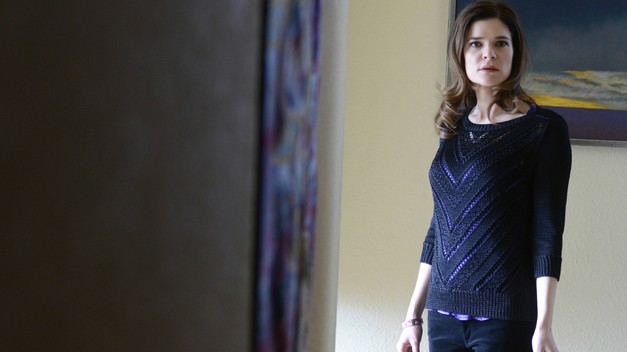
ANNA GUNN, “Breaking Bad”
Being the wife of a criminal mastermind is not an easy thing. Gunn is excellent at portraying the shock, confusion, and helplessness of Skyler White, to the point where her character almost gives up. Her performance in “Fifty-One” is one of the most heartbreaking and intense performances ever given.
MICHELLE FAIRLEY, “Game of Thrones”
Cast members like Emilia Clarke get more recognition, but Fairley is the stand out in season 3. It’s a quieter, less showy performance, but everything eventually crescendoes until it explodes in “The Rains of Castamere”, one of the best TV episodes of all time. It also includes a heartbreaking performance by Fairley.
ADELAIDE CLEMENS, “Rectify”
I usually wouldn’t nominate two from the same show, but Clemens’s performance is amazing. She becomes an emotional center of the show, depicting religion in a way that has never been done before on TV. It’s an unexpected, gorgeous, and nuanced performance.
CHRISTINA HENDRICKS, “Mad Men”
I’m still angry she didn’t win for “The Other Woman”. If she didn’t win for that, she won’t win for a season in which she has less of a major role. However, her time on screen is still well utilized, providing an excellent contrast to Peggy and being a great foil for many people in the office.
.
Who should win? I can’t make this decision.
Others considered: Caroline Dhavernas, Joelle Carter, Emilia Clarke, Maggie Smith, Mae Whitman, Christine Baranski, Hayden Panettiere, January Jones, Kelly Macdonald, Elizabeth McGovern, Betsy Brandt, Erika Christensen, Lena Headey, Regina King, Melissa Leo, Madeleine Stowe, Lauren Graham, Maggie Siff, Rose Byrne, Jennifer Carpenter, Morena Baccarin, Bellamy Young, Annet Mahendru, Jessica Capshaw, Olivia Cooke, Olivia Munn, Deborah Ann Woll, Jessica Paré, Sandra Oh (This is an absolutely stacked category)
.
On to the real nominations…
.
Morena Baccarin-Homeland
Christine Baranski-The Good Wife
Emilia Clarke-Game of Thrones
Anna Gunn-Breaking Bad
Christina Hendricks-Mad Men
Maggie Smith-Downton Abbey
.
Who should win?
Gunn
Who will win?
Smith
Analysis: It’s about time the voters recognized the tremendous work of Anna Gunn, but Smith has the experience, and is riding off of last year’s win. I don’t think there’s much competition here, but if there’s anyone that can pull off an upset, it’s Gunn.
Credit to Sundance, AMC, NBC, HBO, Parenthood, Game of Thrones, Rectify, Mad Men, and Breaking Bad for all pictures. I own nothing.
Strike Back might just be the most entertaining show on television. It’s expertly paced, the characters are well fleshed out for what is predominantly an action-softcore hour, and the action sequences are better than those in many movies.
I’ve found that it’s much easier to review 2 episodes at once, as the seasons follow a 2-episode arc alongside an overarching storyline. Also, I can’t really judge an unfinished arc, as the first hour is usually a set up for the second. As a result, if you check back in next week for the episode 5 review, it won’t be there. I’ll be reviewing episodes 5 and 6 after the end of 6, 7 and 8 after the end of 8, and so on.
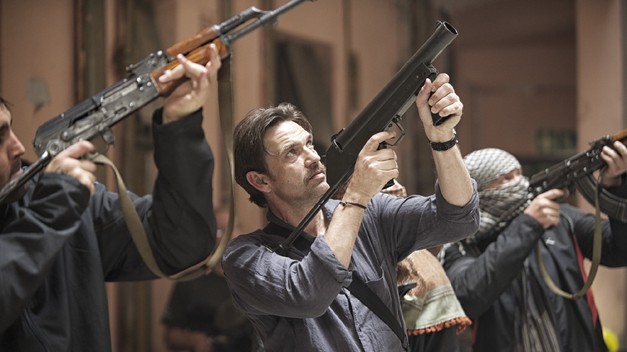
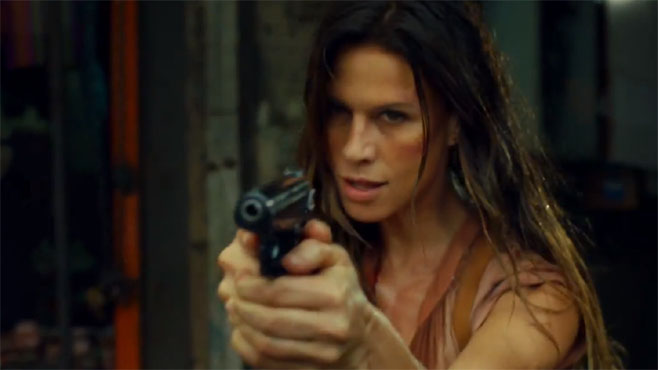
Anyway, back to the episodes. Introduced in episode 3 is Dougray Scott’s Leatherby, a charismatic, entertaining, and violent villain that is an absolute blast to watch. In addition, Kamali’s daughter, Ester, becomes a factor, giving us more of an insight into his motivations and his mental state. In fact, these two episodes build up the parallels between Kamali and Rachel Dalton (Rhona Mitra), both inherently tragic characters that we come to sympathize for. Both have to make decisions that transcend their adherence to the rules of their respective organizations (Kamali and his daughter, and Dalton and al-Zuhari’s wife). Both, in a way, succeed, as Dalton’s suspicions are validated and Ester is removed from harm’s way. Both, in a way, fail, as they both wind up getting shot. Dalton already failed, though.
What do I mean by this? Well, her arc this season has been one of self-destruction, causing her to become unhinged and desperate, determined to find and kill those responsible for Baxter’s murder. The waterboard sequence is tough to watch, and it’s a prime example of watching someone unravel before your eyes. Her death has been telegraphed since the start of the season, and when it finally comes, it’s handled extremely well. The show does a great job of maintaining that level of suspense, inducing a sense of both uneasiness and hope. We have a sense that she’s going to meet her demise, but we also have a feeling that Stonebridge and Scott will once again save the day.
Alas, that does not happen. It’s a smart way to end her arc and introduce a strange new one. She’s killed off by an IRA assassin, a new, mysterious threat to Section 20 that I’m interested to find out more about. Speaking of smart ways to end arcs, Leatherby is also killed off. I have to commend the writers for sticking to their original format and preventing him from overstaying his welcome, but also can’t help but wish his storyline had been expanded upon over a greater number of episodes. We’d be able to get a more nuanced look into his personal life, especially in regards to his boyfriend Fahran. Instead, he’s over the top in general Strike Back fashion, which is still fine. The relationship is still handled with the right amount of complexity, and it ends tragically.
The pacing in these two episodes is extremely well done, and I’m impressed at the number of storylines they weave together throughout the two. For example, they throw in Scott’s relationship with Ester, reflecting his nagging feeling of need and the fact that he has not family. Everything these two do is, to quote Leatherby, “Fun”, but it prevents them from really settling down. Still, it’s all fun. These two episodes move at breakneck speed, jumping from action scene to action scene, whether it be a chase through a minefield or a shootout in the street. They are showcases for the brilliance of this show.
Grade: A- (Episode 3: A- Episode 4: A)
Other thoughts:
-I’m sad to see Rhona Mitra go. That picture above explains why.
-The minefield sequence is a perfect example of why this show is so endearing. It expertly blends humor and action into one thrilling sequence.
-“You should really teach English as a second language.” -Stonebridge, after Scott stabs a guy.
-The music and the close-up of Leatherby’s face before he shoots his boyfriend is kind of unnecessary.
-See you in 2 weeks.
Credit to Cinemax and Strike Back for all pictures. I own nothing.
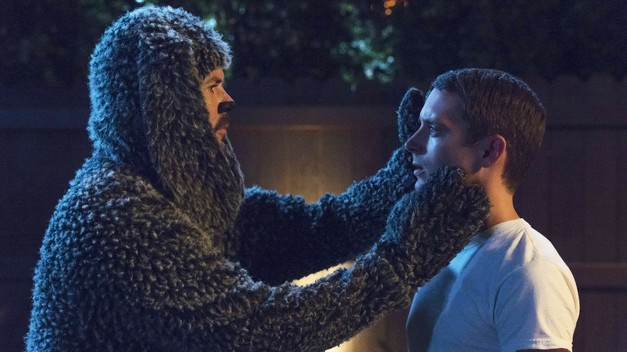
Well, that was…interesting. The final shot of the third season of Wilfred is of Ryan in a forest, unearthing a statue of a man in a dog suit. It’s a moment that’s perfect for a cliffhanger, intended to be intense and mysterious. However, it comes across as tacky and unnecessary. Let’s break down why.
Ryan’s dad has always been a fundamental part of the show, even without his physical presence. He’s been hovering over these characters’ heads, influencing Ryan’s life in ways Ryan himself does not want to admit. Wilfred is important, but he may very well be a manifestation of Ryan’s inability to let go of his childhood. The series is about him maturing as a person, and his dad has impeded that natural progression of events.
This is exactly why I was excited to hear that his dad would be brought into the fold this season. However, I feel like the writers only scratched the surface with this relationship; it was a unifying storyline, but it jumped around the other side stories way too much. The weaving was less effective in this season.
That’s not to say I didn’t enjoy the season (there are a few absolutely amazing episodes), or the episode. I love Wilfred’s reunion with Ryan, as it conveys true sadness on both of their parts. It’s heartbreaking and endearing, and it reminds you why you’re watching this show. The Jenna stuff, on the other hand, feels a bit generic, just like the rest of the season. The show pushed the boundaries in seasons 1 and 2, and I feel like they took a step back here.
As for the decision to kill off Ryan’s dad, I’m left disappointed. I guess that it is a smart move on the part of the writers, as they can maintain the ambiguity they’ve created with the character. However, it comes across as an avoidance of Ryan’s father issues. I hope that next season, the writers focus on him coping with the death, and not with the new overarching mystery. I don’t think that will happen, but I’d really love it if Ryan worked to make himself better. If that means the series has to end, then so be it. I want to see a natural progression of events, not some meandering plot that dances around a big mystery the whole season.
It’s not a bad episode. I’ve made it out to be worse than it really is, but that just stems from disappointment.
Grade: B
Season Grade: B
Other thoughts:
-So Ryan’s roommate is a spy! Okay.
-We also find out that the pro bono division managing job is actually real. It’s an interesting decision that I hope will be handled well next year.
-“What’s next, landscaping camp?”
-“At first I thought it was you, but then I thought about what you look like, and act like, and how you struggle with dandruff and stuff, and honestly I just burst out laughing.”
-Renewal is not a given. The show has been struggling, especially without Louie as a partner, but I hope FX allows it to end on its own terms. Hopefully I’ll see you all back here next year for season 4.
Credit to FX and Wilfred for all pictures. I own nothing.
The first few minutes of this episode of The Bridge is devoted to a flashback, one that takes us right into the tragedy of the car crash that claimed David Tate’s family. The camera focuses on his tear-drenched, anguished face, and we hear his miserable screams as he watches his family getting pulled out of the car. It’s almost as if we’re in a dream, and we feel his pain. The scene lasts for a few minutes, but lingers for even more than that.
The main plot involves Tate’s kidnapping of Marco’s family, one that anchors a tightly plotted, intense episode. It seems as if the writers have committed to the revenge storyline, which, as I said last week, certainly limits the scope of the show. However, a commenter pointed out that it’s always possible that Tate isn’t ‘The Beast’. I’m dubious that there would be this much misdirection near the end of the season, but who knows? The reason given for his murders, though, is satisfying, as it combines elements of his personal life with the political ramifications of certain actions taken by the police departments.
Anyway, the episode really attempts to humanize Tate, a task done so both by the opening sequence and a scene on a playground. No, the scene in question does not involve Tate yelling “Yaaaaaay!” as he rides down a slide backwards. It involves him pouring out his heart to Alma, and he does so even with the knowledge that he intends to kill her. The pain in his eyes is genuine. Everything he says is true. He’s a desperate, vulnerable man that has been forced to resort to revenge to give him purpose. It’s only fitting that Alma, a vulnerable woman cheated on by her husband, would be so drawn to someone like Tate. They share a common bond of loss, and it gets her into trouble.
Side plots once again involve Linder and Charlotte, both dealing with death in their own ways. They also both look for advice, Linder in the form of a ranch owner and Charlotte in the form of Cesar. They both have to ask if their murder was justified, and they both have to grapple with their moral values.
The character moments in this episode work for me, but yet again, the plot is questionable. For example, take the final scene. How does Tate know when and where Gus is going? The final scene feels contrived, especially as a way to juxtapose with the opening. Tate lost his son, so he’s now going to take Marco’s son.
For the most part, the episode works for me. It contains a very well-constructed central plot with great character development and some questionable plot points, but it’s very enjoyable.
Grade: B+
Other thoughts:
-I guess a tracker, maybe?
-On Charlotte’s plot: I’m glad we got more advancement here, and I’m excited about her team-up with Cesar.
-“MILF? I don’t have children.” Sonya, you are amazing.
-Demian Bichir did great work again. He portrayed a desperate, determined man very well.
-Linder and the ranch guy’s conversation about food and death was one of the weirdest, yet most hilarious, things I’ve seen on television this year.
Credit to FX and The Bridge for all pictures. I own nothing.
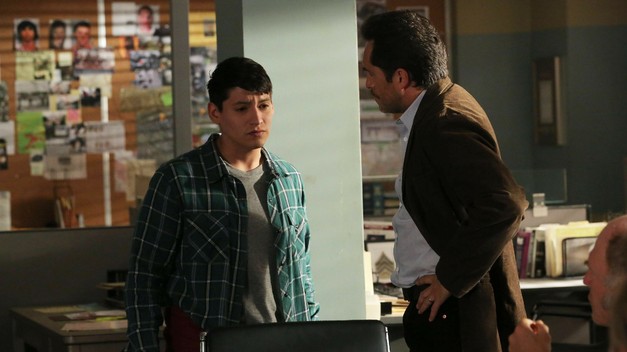
Ah, it is great to have Sunny and all its brutal, yet hilarious, gang antics back on our television screens. I still don’t quite understand the necessity of three FX channels, but there’s nothing I can do about that.
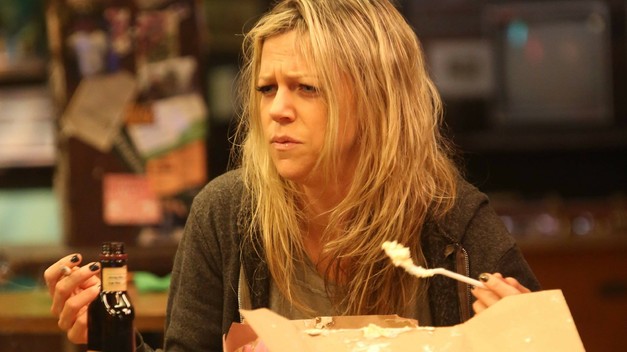
Anyway, this episode is a hilarious kick off to this penultimate season, showcasing the talents of Kaitlin Olson and Glenn Howerton in particular. The episode starts off with Dee in the bar, drunk and depressed, and the rest of the gang trying to remedy that. However, these people never really produce anything good from their ideas: more often than not, the situation becomes a huge fiasco that spirals downward endlessly.
This isn’t exactly where this episode goes, though (at first). Dee becomes increasingly popular as a stand up comic, delivering sound effects and vagina jokes galore. Dennis, meanwhile, is preoccupied with making sure Dee finds an “average guy”, trying extremely hard to convince himself that she isn’t abandoning him for better opportunities. It’s kind of a depressing arc, but Howerton plays it extremely well.
It all leads up to that final scene, one that completely surprised me in terms of its cruelty and unexpectedness. The gang reveals that everything that happened was a hoax, designed to really crush Dee’s spirits and get her to embrace her true “average-ness”. The true brilliance of this, though, is that it happens to have a more profound impact on Dennis, leaving him a blubbering mess. It’s the capper to, as I said before, a depressing arc, but the show weaves in comedy so well that it really just becomes what it always has been: It’s Always Sunny in Philadelphia.
Grade: A-
Other thoughts:
-Olson’s dry heaves and her blowup at the end are things of beauty.
-The rest of the cast still got in some great lines, though. Charlie’s delivery of “Did you kill yourself, Dee?” was pitch perfect.
-“She said vagina! It’s funny because a woman said it!”
-“Dee. Dee. Dee. Dee. Da. Da. Da. Da. Dee. Da. Dadedadedade……etc.”
-I couldn’t help but think of Breaking Bad with the whole Walt business. Also, Huell was there!
-“She knows your goddamn name, Walt.”
-“The crabs have machine guns now. That makes sense.”
Credit to FXX and It’s Always Sunny in Philadelphia for all pictures. I own nothing.
FOX has officially confirmed that the new season of American Idol will consist of new judges that will almost certainly be replaced. These judges are Harry Connick, Jr., Keith Urban, and Jennifer Lopez, who apparently got bored of being Jennifer Lopez and decided to return (who can blame her?).
This is Urban’s second year on the show, a feat only surpassed by spending three years on the show, at which point he will probably melt into his chair and be eaten by a mob of screaming idiots. Not to fear, though, as judges on American Idol now have a shelf life of “Not long”, or the equivalent of a quickie in terms of judging a singing competition.
All three will be paid a lot of money, and they will sit at that table and pander to the general public, completely ignoring the nobody singing on stage. They will also all be involved in some sort of romantic plotline, consisting of Keith Urban screaming “NICKI MINAJ IS A RAPPER” a million times over and Connick, Jr. and Lopez frolicking on the table while Randy Jackson watches and offers up some excellent advice: “You did good, dawg.”
Then, Americans will vote, people will be eliminated, Ryan Seacrest will remain rich, and American Idol will still be here in 50 years. However, the judging panel will consist of an infant, an extraterrestrial, and the souls of every human being that has ever enjoyed this show.
Credit to FOX Broadcasting Company and American Idol for all pictures. I own nothing.
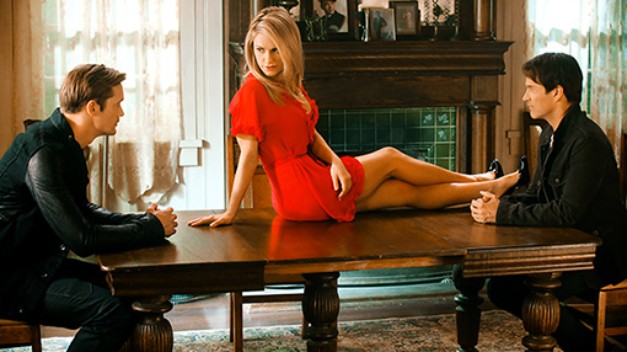
(Spoilers) In news that is three hours old, but has already caused thousands of True Blood fans to cry out in anguish, Brian Buckner, showrunner of the somehow still hit show, announced that the upcoming seventh season will be the last. At the words “seventh season”, the fans all thought for a minute, then nodded their heads as if to say “Yes, this is good.”
The final season, set to air next summer, will presumably involve the aftermath of Eric’s nude inferno ice glacier book-reading whatever the hell that was. This will consist of Eric standing in the background of every scene, nude and on fire, not noticed by any of the other characters. They will apparently have more important things to do, like having sex in the woods or being uninteresting.
Buckner insists that “as we take a final walk through Bon Temps together, we will do our very best to bring Sookie’s story to a close with heart, imagination and, of course, fun.” This is, of course, interesting wording, as Sookie’s walks usually lead to danger. I can only infer that heart, imagination, and fun will jump out of the woods and tear her to pieces, but not before she meets a random hot guy that wants to kill her.
The season will consist of 10 episodes, continuing the format of the last season.
Also, Alcide will be there and he’ll take off his shirt or something.
Credit for picture to HBO and True Blood. I own nothing.
This is a facetious line said in passing by Saul Goodman, but it is extremely interesting in the context of the other characters. For example, does Walt really care about Jesse? Deep down, do the experiences they’ve shared transcend the suffocating nature of Walt’s current situation? There’s no question that Walt has looked at Jesse as a son, but does he still? That’s something to be debated upon, but I’d argue that it isn’t until he picks up that phone, and the end credits roll, that he truly turns on Jesse. He’s been heading down a path in which his paternal feelings have become feelings of necessity, as his whole family’s been turning on him.
As for Jesse, all throughout this process, his mind is telling him that Walt doesn’t care at all. Walt’s burrowed deep into his brain, filling him with fear and paranoia. He doesn’t look at Heisenberg as a father figure, but he looks up at him; he believes that Walt’s the devil, capable of anything and everything. This is exactly what’s gnawing at his mind as he walks through that plaza, in a scene reminiscent of “Half Measures”: the same angle, the same expression on his face, and the same feeling of “This is the longest walk ever.” Everyone around him is appearing and disappearing, reflecting those “godlike” qualities he’s so afraid of. Then, he’s able to fixate his attention on one person, causing him to completely change his mind and threaten Walt over the phone. Sure, that creepy guy standing there in the plaza is a plot contrivance designed to increase tension, but it works because it gives Jesse a new direction to take.
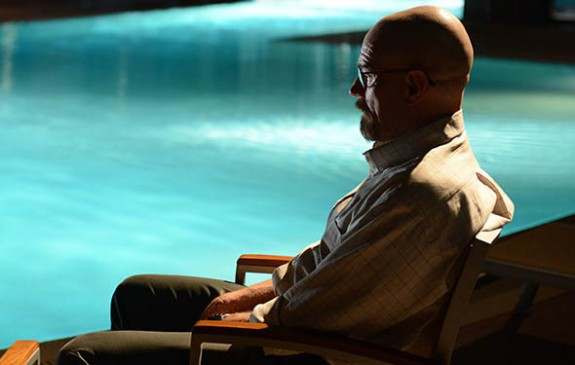
Let’s back up a bit, though. The set up for that final sequence is extremely interesting; it’s full of conversation, but those conversations shake up the character dynamics. First, we see Walt trying to explain to Skyler and Walt Jr. why exactly gasoline is all over the floor. Then, we see Walt and Flynn bonding by the pool, and later, we see Walt continuing to avoid telling Skyler the truth. Heisenberg’s always been a cold, calculating man, capable of creating an elaborate plan months in advance. However, when he’s confronted by Flynn and Skyler in this episode, he’s shocked. He’s flustered. He’s confused as to why his lies aren’t being lapped up. He’s starting to crack. It’s chilling, though, that in the same episode that Skyler puts off confronting Walt because of the presence of Walt Jr., the father and the son get closer than ever before.
Then, we have Hank. He’s become embroiled in his quest, and he’s entirely willing to bring Jesse down if that means nabbing Heisenberg (ironic, isn’t it, how only Walt seems to care about Jesse in this episode?). His way of responding to Walt’s “confession” is to acquire a confession of his own. However, Jesse’s the voice of reason here. He has no legitimate proof of Walt’s criminal activities, and his full and honest confession has less of an effect than Walt’s “manipulating the truth” confession. We see two different men in these videos; Jesse’s slouched and mumbling, but Walt’s staring straight into the camera, exuding power and confidence.
So, that brings us back to Jesse’s final decision. We don’t know what it will be. Perhaps he’ll claim to be Heisenberg, or perhaps he’ll move to Alaska and build a snow fort. One thing is for sure, though: Walter White cannot be a part of him any longer.
Grade: B+
Other thoughts:
-The episode is “Rabid Dog”, drawing comparisons to Season 4’s “Problem Dog.” It was an episode in which Jesse had to explain why he killed Gale, and this episode serves as a complete shift from that, as Jesse’s now the one being treated like a dog. Who is the dog? Jesse could be, but it can just as easily be Hank.
-“Okay, but, say, you know, just for the sake of argument, the kid’s not in the mood for a nuanced discussion of the virtues of child poisoning…” Oh, Saul. You’re amazing.
-The shot of Jesse out cold in Hank’s bed is a powerful image. He’s lost, beaten down, and emotionally drained.
-Of course, he wakes up to a picture of Walt as Santa. His reaction to that is golden.
-When Jesse’s phone went off, I thought that we were going to get a montage of Marie making lasagna. Maybe next week.
-Marie goes to therapy, and we see more purple stuff.
-The directing of the show always impresses me, and Breaking Bad directors in particular are brilliant at “hallway shots.” The framing, the pull backs, and the zooms are pitch perfect, and I’d like to point out the scene after Jesse wakes up. He’s at one end of the hallway, and Marie’s at the other end. It’s a wonderful shot.
-The B+ doesn’t mean the episode is bad, but I think it does move a bit slow. However, that’s what piece-setting episodes do, and while the episode is less compelling than the last three, it sets up for what should be an explosive episode 5.
Credit to AMC and Breaking Bad for all pictures. I own nothing.